

JACK KIRBY: The Power of Simplicity
If You Don't know JACK, YOU DON'T KNOW SH!T!

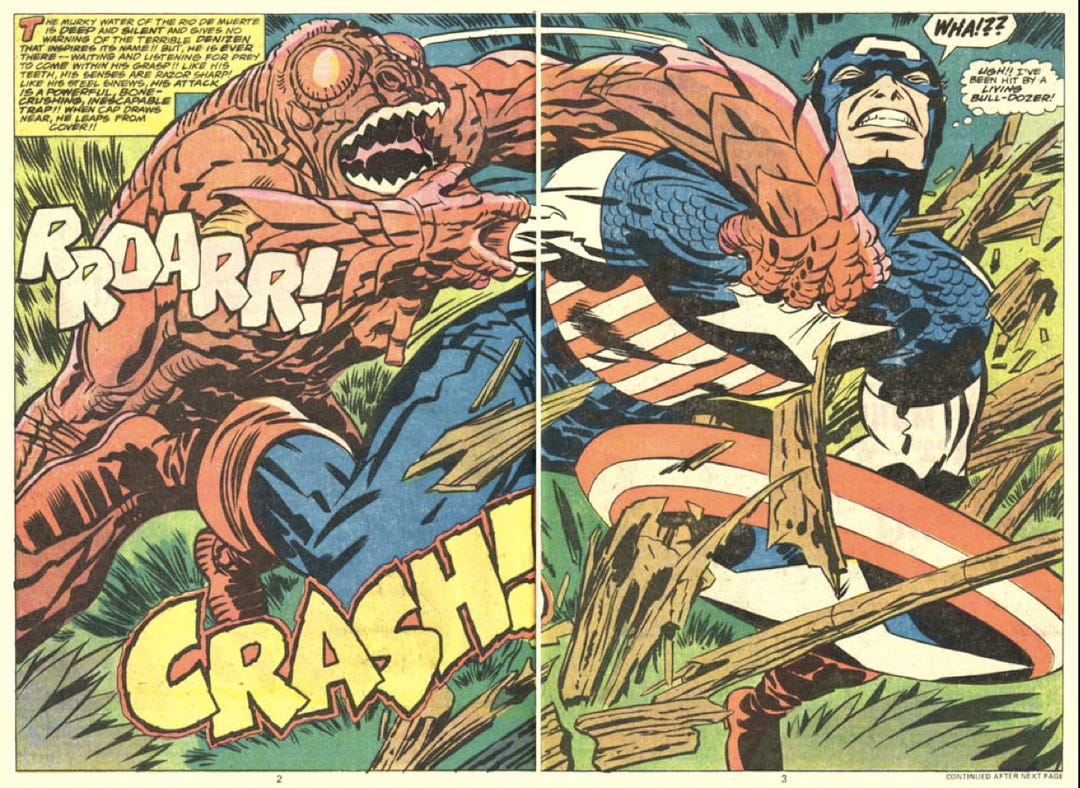
If you don't know who JACK KIRBY is, I don't know what to tell you. Hopefully by the time you finish reading this you'll see why I am among the legions of fans and comics practitioners who appreciate his work. But it wasn’t always that way. As a kid, I didn’t understand what I was looking at. Why did these figures look like broken toys?
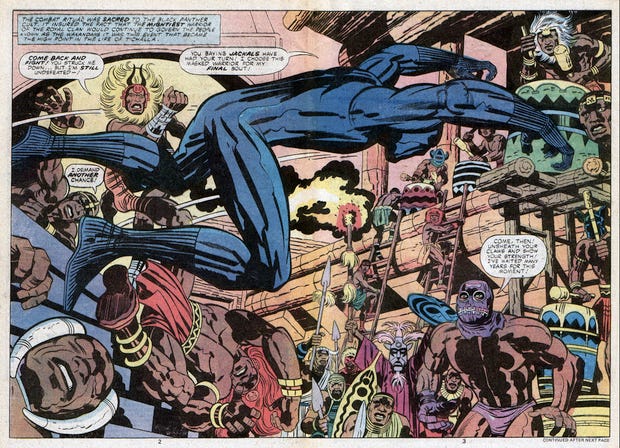
He, along with Stan Lee, created the very foundation of the Marvel Universe. Even before he met Stan, Jack and Joe Simon created Captain America. It stands to reason that he's had an impact on comics and modern day 21st century entertainment. SEE ALSO: Marvel Movies.
Admittedly as a young artist I didn't understand Jack's work. The lead image to this post is the one that got to me. It actually scared me as a child. The bold large shapes of the figures are easy to read, even in a thumbnail size. That's where most of the power comes from in Kirby's work. Simple shapes are more memorable than complex shapes. Strong silhouettes are easier to read, and our brain processes them as symbols. Because these symbols are used time again in, they become pillars of effective storytelling.
Another point to consider are the bold passages of black. Whether it's an outline or spotting of blacks, they are the tools that were used to separate large forms from each other for Kirby. Balancing these elements were essential to bring focus where he wanted the action to be or where he wanted the viewer to look. When you break down some of the squiggles and random shadow lines, you start to realize that they do less to create form and volume for the shape they're on and more as stylized touchstones. Especially in the penciled image of Black Panther below.
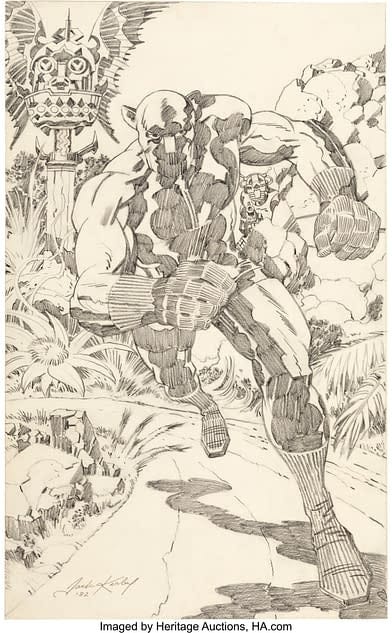
If you squint, you can see how heavy the shadow passage is an how it holds the center focus of the entire image. Everything else, thick and thin line, support this. The shadow on the ground has very little to do with any actual lighting, but it does enough, convincingly to cement the figure.
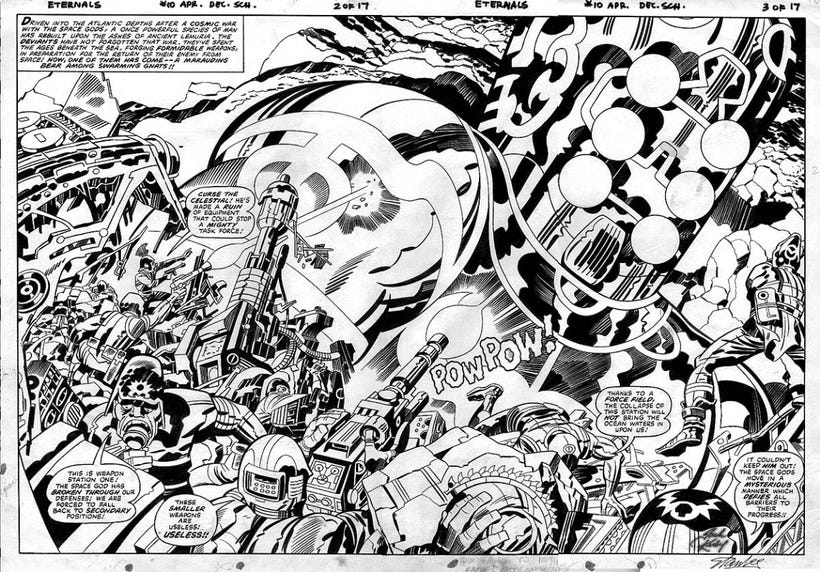
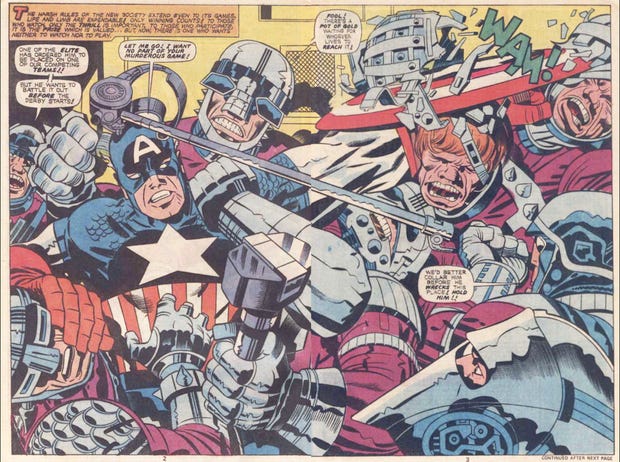
Another element that Kirby uses is scale. Whether it’s objects that are juxtaposed next to each other or the scaling of the detailing and negative space used, as in the large metal creature above. In conjunction with all the smaller characters fighting it, the creatures large areas of light are where the eye rests. The open, un-shaded eyes especially where we look first. Seeing his work without color really show how the early days of flat color had less influence than today’s very rendered colors.
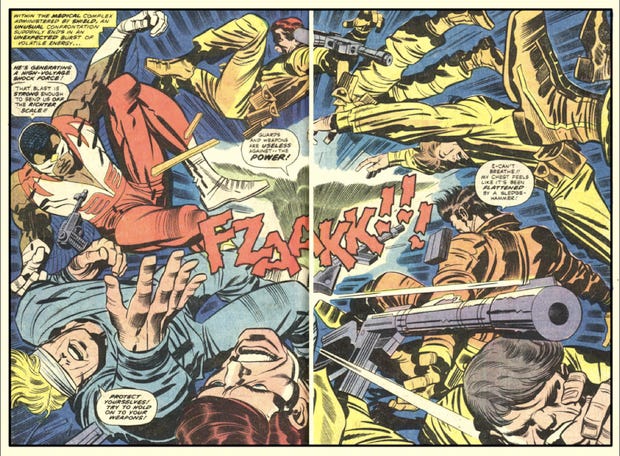
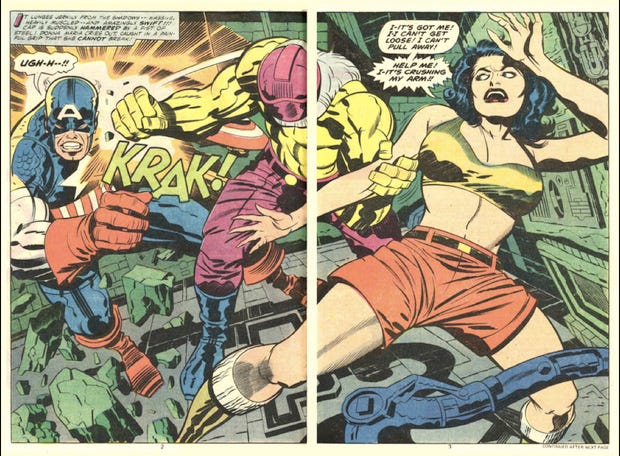
In my own work I rarely ever consider the double-page spread. To me they can tend to interrupt flow and should be used sparingly. They provide a dynamic cinemascope look of an event, or to show impossible scaling of destruction, expanse of an environment or a powerful character moment that would make no sense in a single splash page.
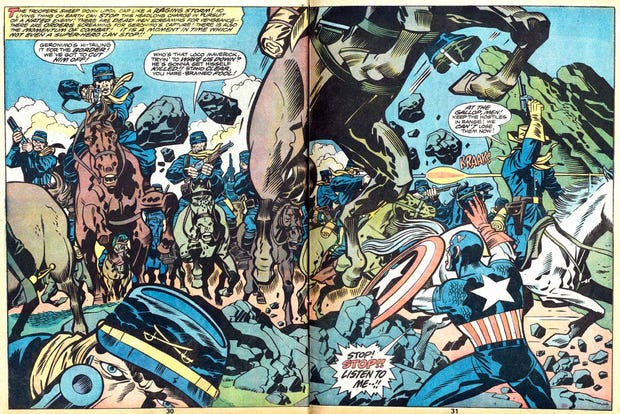
But over the years I’ve seen them used in less stellar ways that became wasteful and did nothing to propel the story forward. Kirby understood the basics...and as far as I know, may have invented the use of the double-page spreads, but I don’t have any evidence to support this at hand.
Because Kirby was cranking out several books a month, he relied on his shorthand for the figure and environments to become how he solved all the problems he needed to tell Stan Lee’s stories. The unfussy, unresearched art delivered the highest impact with efficient clarity. Matched with a good inker like Mike Royer or Frank Giacoia the combination was riveting.
The above samples are a select few, but I encourage you to dig for more as they are very rewarding. Comparing today’s comics and seeing Kirby’s work is like watching Toy Story 12 or whatever and then turning around and watching Don Bluth’s the Secret of Nimh. Life just pours from the hand-drawn animation no matter how excellent the character animators are at Pixar.
Nobody drew power like Kirby. And I’ve yet to see anyone do it better.
=s=
What a genius Kirby was. I inked that black panther pencils several times, it is just FUN! As you mentioned, some lines don't add shape or deepness, but rather are abstract elements that Jack used to communicate "action", "speed", "power" or even emotions, somerhing way beyond his time.Many other artists I heard were "too true to anatomy" to go the Kirby way, like Neal Adams, that himself confessed with respect in an interview, not being able to go so far :-)
Looks good Lance! Subscribed!