

Long Story Short ★ PAUL CHADWICK
Classically Trained but TIMELESS in His Approach to CREATIVE STORYTELLING

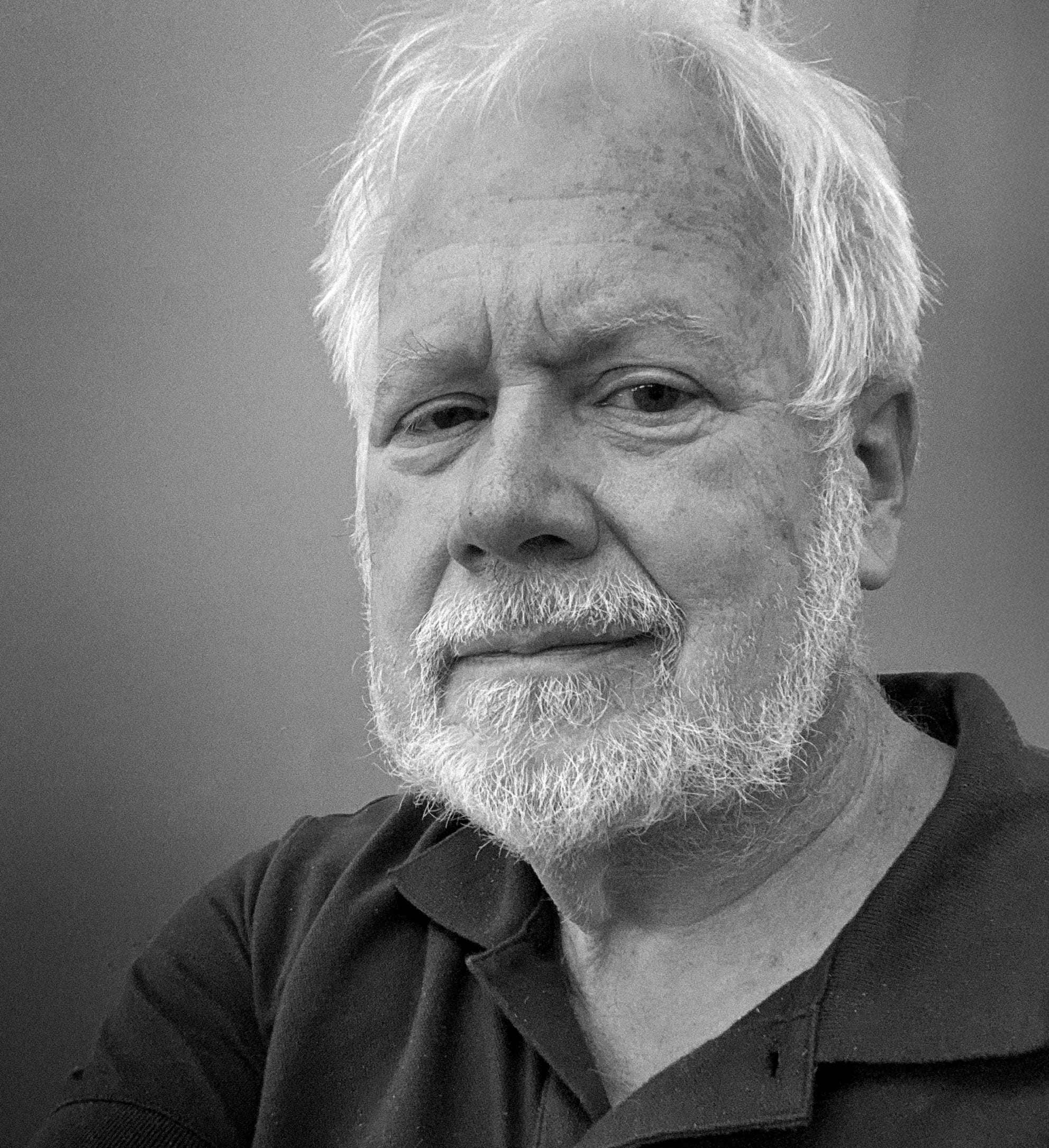
Hailing from an isolated island in the Pacific Northwest, PAUL CHADWICK is a quiet legend with fierce talent whose work, whether writing or illustrating, carries a much-envied signature of relatable human experiences.
BTP: I’ve wrestled with where to start this interview. You’ve had such a dynamic career and brushed up against so many interesting people that it boggles my mind. And yet...and yet, you live on a secluded island in the Pacific Northwest like one of those creative mad geniuses who needs a way to separate themselves from the world. There are a few of those in this area. But I think where I’d like to start is with STORY. Where did your love of story form, and how is it that no matter what you write, whether a blog post or a comic, that you’re able to get to the soul of the material so quickly?
CHADWICK: Well, everybody loves story. It’s emotionally charged learning. I think Brian MacDonald’s theory that storytelling was invented to impart survival information rings true. I imagine hunters and warriors came back with gripping stories, with life-or-death consequences, loaded with lessons for hunters-to-be. Same for gatherers — I ate the dark red berry and immediately started puking!
BTP: I’d heard that as well. It makes me wonder how many tall tales were born around the fire...and what was that branching off point where people embraced real fiction to perform or reenact for entertainment’s sake. Did it really all start with the Greeks? What are some of the greatest lessons that story has taught you about how to live?
Prefer a downloadable PDF? Get it here.
CHADWICK: Daunting question, which makes me wonder what the hell I know about living. Amusingly, what comes to mind is a passage in a Travis McGee novel about how if an attack dog leaps at your throat, the only good move is to grab its paws and hurl it past or over you. Useful, I’m sure, but so far, I haven’t needed that one.
Persist despite failures, I guess. A lot of stories reinforce that idea. Make alliances. The hardest thing, emotionally, is usually the right thing to do. The best teacher is things going wrong; I think most wisdom is “I’ll never do it that way again.”
BTP: Most who excel at writing are avid readers. What were some of the works you gravitated toward and were they the same ones that influenced your own personal style? Are you still inspired or have time to read these days?
CHADWICK: Three writers important to me in my youth remain touchstones. Kurt Vonnegut, with his wit, sorrow, truth-telling and understated metaphors left grooves in my brain.
Less known, the lyrical science essayist Loren Eiseley showed me the pleasures of wonder and mystery in the natural world. He too had a voice of soulful melancholy, but unleavened by humor. His nature writing and personal essays (including his autobiography) are full of autumnal beauty.
Finally, the pulpster-turned-mystery-grandmaster John D. MacDonald thrilled me with his suspense, action, and unusually intimate voice. Particularly in his Travis McGee series, he struck one as being frank, worldly-wise. He seemed to know a lot about the adult world, particularly relations between men and women (though dated now, very midcentury), and the dark parts of human nature. I learned the word sociopath from him. He even wrote authoritatively about business and finance (he had a MBA) and their intersection with criminality. You might call it survival information.
I’ve never been able to mine my favorite author, Jack Vance, for influence. Like Lord Dunsany, if you try to imitate him you run the danger of being mannered and precious. His plots are satisfyingly straightforward adventure and mystery — but his inventiveness with locales and cultures and SF concepts is absolutely charming and wrapped in crisp but idiosyncratic prose. His power of description is thrilling. I was pleased to learn Michael Chabon was a fellow fan.
Doomscrolling and internet news addiction has perniciously cut into my book reading as I’ve aged. But I loved Scott Turow’s latest legal thriller, Presumed Guilty, and am reading a collection of Andrew Vacchs’s hard-boiled stories right now.
BTP: There are some solid choices in there. Andrew Vacch’s HARD LOOKS was my first exposure to his work. That guy’s lived just as hard as he writes. In terms of artists, who were some that guided you through your youth and how has that changed over the years?
CHADWICK: Those early influences linger. The young brain is wet cement. Someone gave me Burne Hogarth’s mid-seventies Tarzan graphic novel when I was fifteen, and I later acquired all his drawing books. Much of my sense of the human figure comes from Burne.
A decade later I took his class at Otis Art Institute in Los Angeles. A quirky autodidact, he was full of odd theories. One class he explained how the word “Christmas” predated Christ. He thought Jackson Pollack’s drip paintings were depictions of atomic structure. But oh he could draw, and was compulsive about it. He corrected one of my drawings, and couldn’t stop rendering it further for ten minutes. So I have a Hogarth original.
Elizabeth was also in his class. We were married less than a year later. I have a lot to thank Burne for, may he rest in peace.
He had the nicest death imaginable. In his eighties, he went to the Lucca comic art festival in Italy, where he was feted as a genius. Europeans seemed to esteem him more than the American comics world. Then he went to Paris, where he died in his hotel room. We should all go out on such a high note.
Other special art heroes of my youth: Jim Steranko, Frank Frazetta, Wally Wood, Jack Kirby, and Alex Kotzky. I still have a thick envelope of Apartment 3-G strips I clipped. Wish I could draw pretty women that well. I’m also quite fond of Basil Wolverton’s cheerfully grotesque work, and that of the hippie eco-optimist cartoonist George Metzger, whom I was honored to interview before an audience last year at a Vancouver BC convention.
BTP: I’ve heard the word ‘humanist’ in conjunction with your name several times over the years. Is this an accurate representation of your beliefs, or is it something that you sought out for yourself over the course of your life?
CHADWICK: You know how smart teenaged boys sometimes glom on to Ayn Rand as a philosophical guide? I did something similar, but with a radically different figure: B. F. Skinner, the behavioral psychologist. His answers made sense to me — we really don’t have free will; our behavior is shaped by contingencies of reinforcement (crudely, rewards and punishments visited upon us by our environment — but it’s complicated in the details). It’s not only an irreligious stance, denying a soul; it denies agency. It’s even suspicious of consciousness itself!
Skinner was part of the Humanist world, though controversially. When he gave his speech after being named Humanist of the year, he was heckled. But he led me to that world, and I subscribed to the American Humanist Association’s journal for many years.
The AHA put out two iterations of “The Humanist Manifesto,” which generally track with the values of liberal societies of the post WWII era (democracy, human rights, women’s rights, gay rights, emphasis on science and social progress). Last I looked, my values were generally in accord with those.
Kurt Vonnegut for a short while was the organization’s honorary president. He used to say Humanism encourages people to act decently not out of fear of punishment after death, but because it brings more happiness and accord to life.
That said, I’m not militant about these matters. The person I love most in the world is a committed Catholic. People much smarter than me are very religious and feel the presence of God every hour. I could be very wrong about all this, but I still suspect once my brain activity ends, I’m erased.
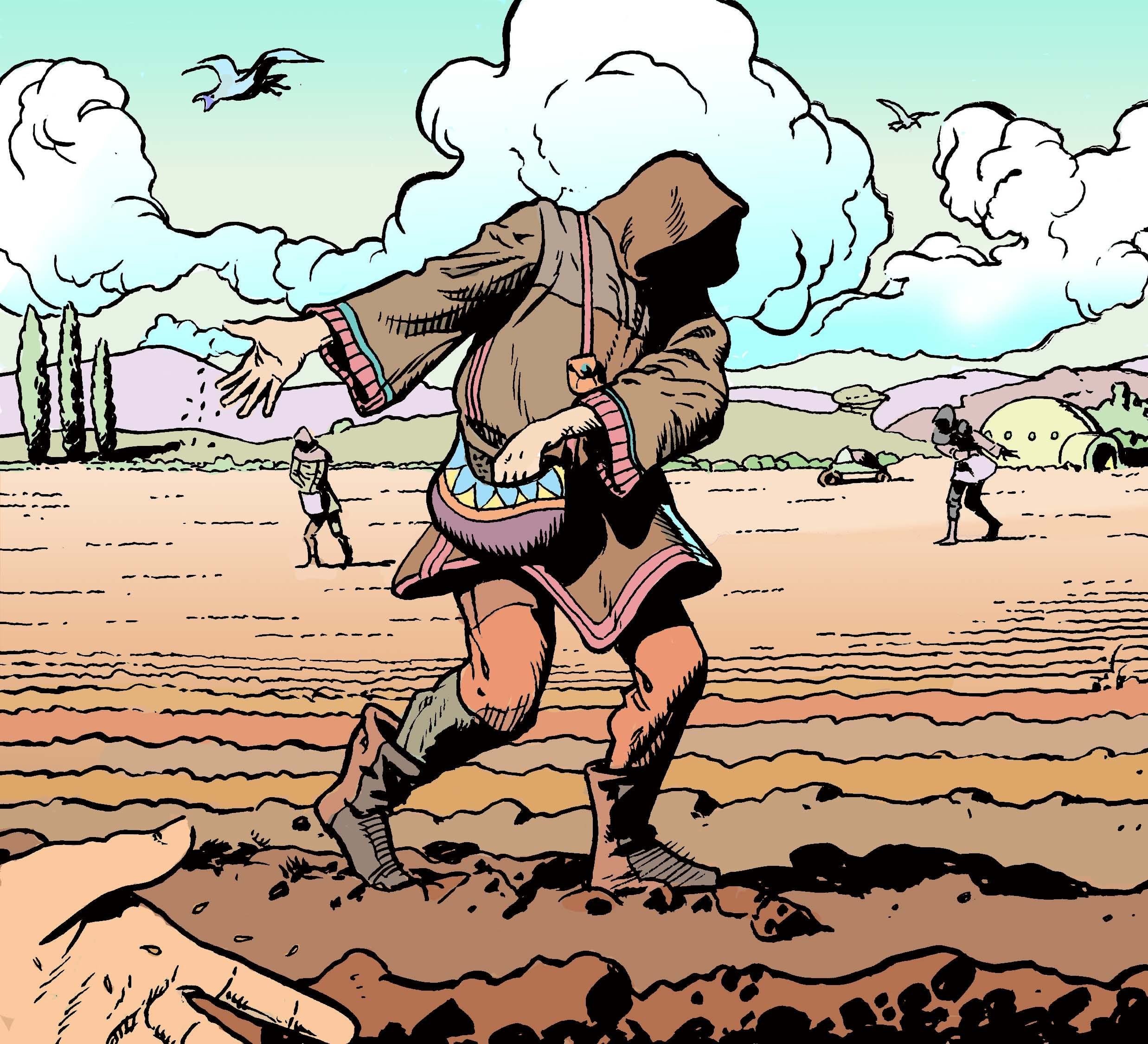
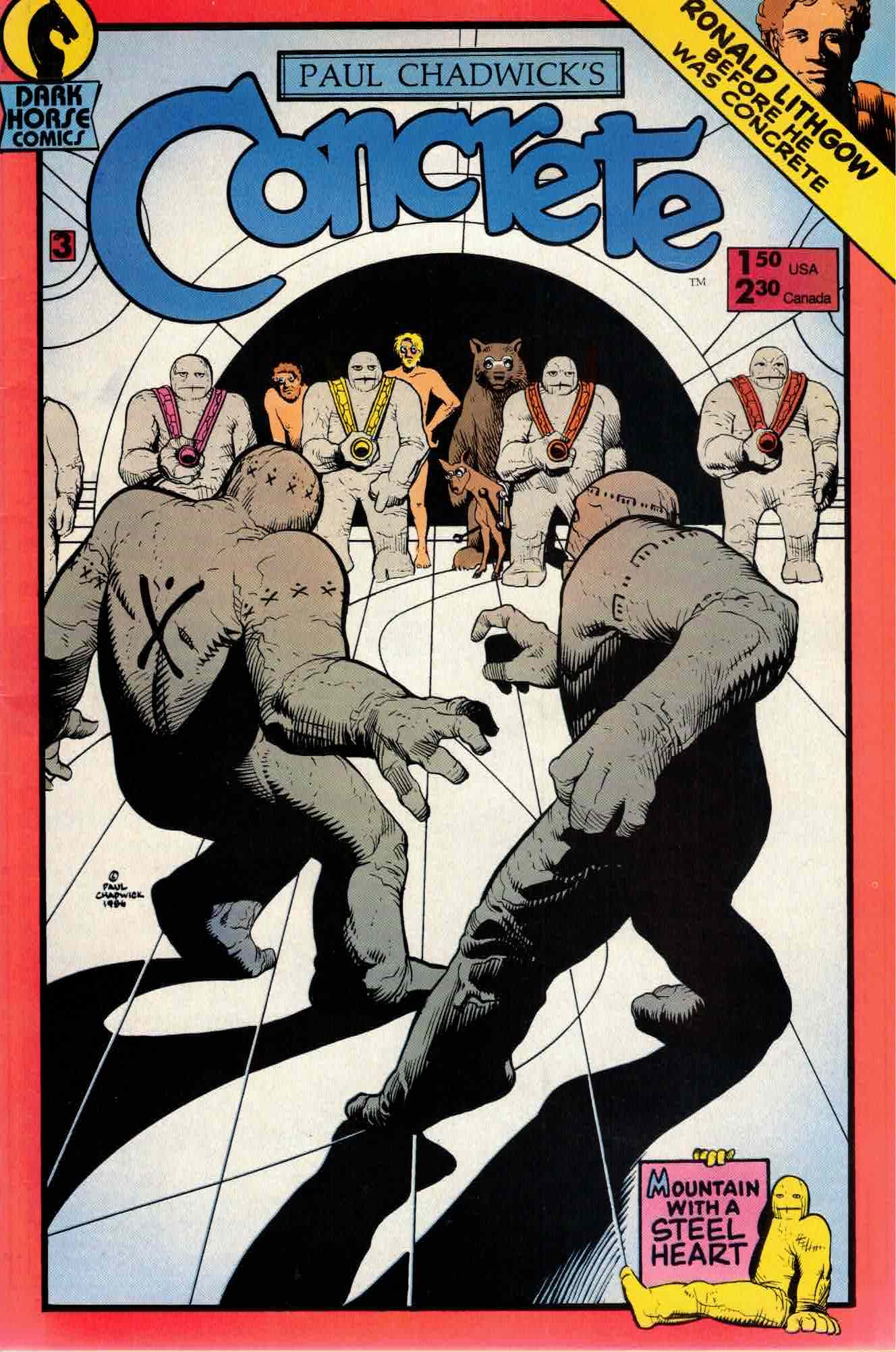
BTP: There’s a certain pragmatism to that approach to life. It keeps things simple and straight forward without necessarily taking a black and white stance. With so many contrasting ideologies floating around these days boiling over from the internet, it’s a wonder people can find any solace or sense of peace in their own beliefs. Yet, when it comes to story it’s these conflicting ideas that are the spine of most stories. No conflict, and you just have a tone poem. Yet, I find that when I read Concrete, there’s a both. There’s a tone to the work that is uniquely meditative, but with real universal conflict. Is this something you’ve had to nurture over your career or was it a natural product of your imagination?
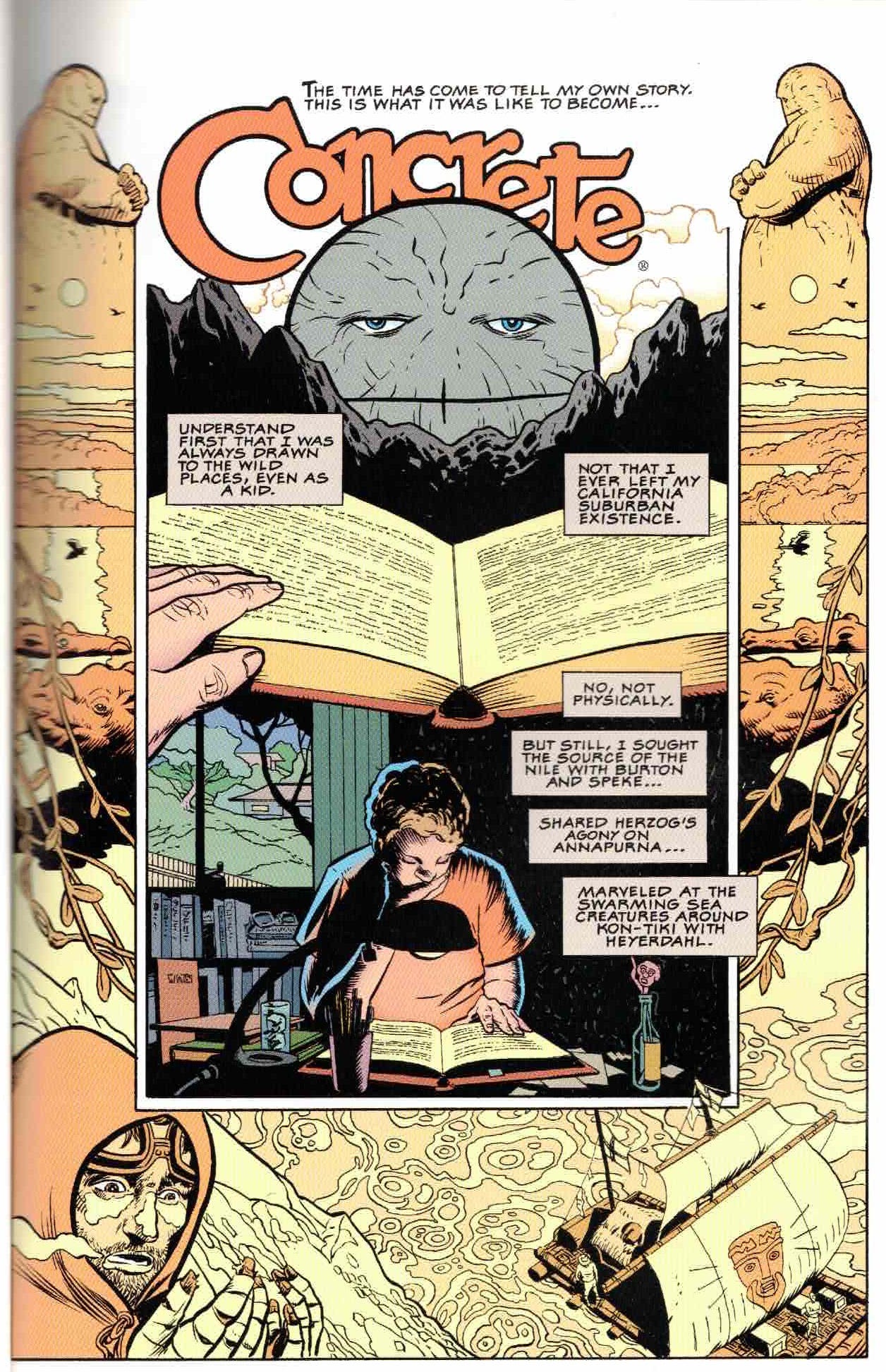
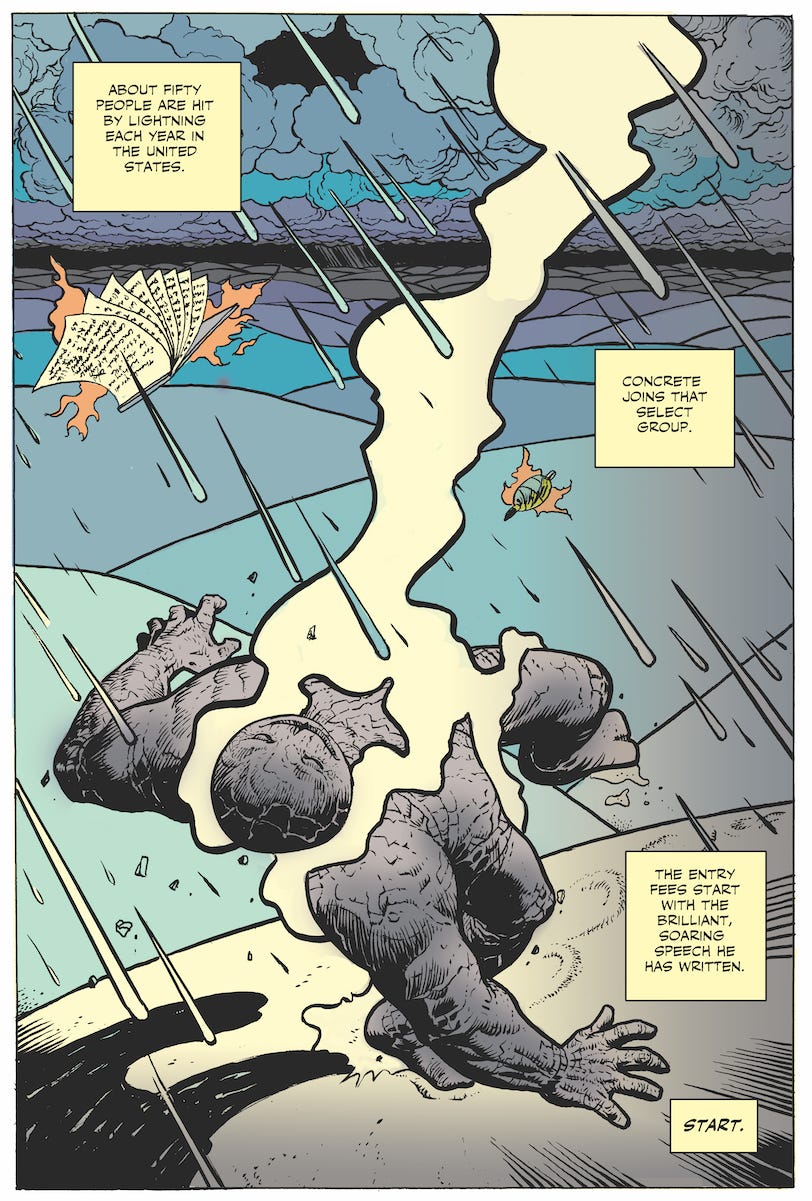
CHADWICK: I think what you’re describing is how along with the action, and the conflict it contains, Concrete thinks a great deal. Thought balloons are out of style, but I can’t stop myself with them; I like the interior dialogue he has with himself. He mulls things. Concrete and Garfield will probably be the last holdouts, using those scalloped thought balloons.
In the Concrete prose novel I’ve finished, it’s first-person narrative throughout. So Concrete’s thoughts and reactions are in every sentence.
The internet, as you mention, has elevated every voice, including the ones posting with a bourbon by their mousepad. It’s changed the flavor of life. We’re confronted with a dozen conflicts each day which implicitly demand we make some sort of judgment, from political outrages to Karen videos. I’m as drawn in as anybody, and you’re right, it’s not a force for mental calm.
BTP: When you break ground on a new story for yourself rather than for a publisher’s IP what are the different challenges you face as a writer outside of the obvious deadline pressures?
CHADWICK: I’m not aware of much difference in approach. But then I’ve done only a small amount of writing of other people’s characters. One thing comes to mind is when I was scripting and drawing (from Harlan Ellison’s treatment) Seven Against Chaos, a time travel story. In a montage, I wanted cartoon characters from the divergent time streams to symmetrically mirror each other. The funny reptile on the left; Porky Pig on the right. Since it’s a Warner Bros. property, and they own DC, I thought it safe. Not so, Porky had to go! I put in the DC character Spike (of ‘Sugar and Spike’) instead.
I joked that we narrowly avoided the lawyers on the 21st floor suing the lawyers on the 17th floor.
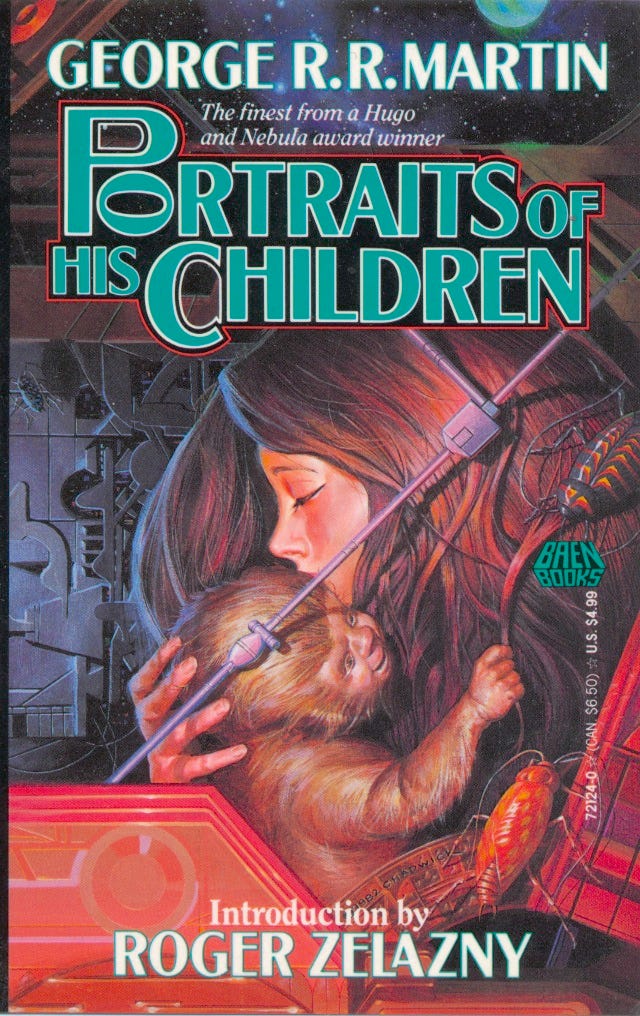
BTP: Haha...that’s rich. I’ve seen a few comics recently that have done that successfully, which for some reason aligns with my approach to comics. I just like throwing ALL THE ART SKILLS I can at every project. But even still, when it’s Work-For-Hire, do you find it hard to wrap your head around the world in which you’re invited to play, and the expectations of what the fans of that world need to experience? How do you keep your voice in all that?
CHADWICK: Well, I guess I stick to my miniaturist instincts. I seldom do stories that embrace the enormous built-up worlds and continuities. My Superman story was just about a guy who’s despairing because his car is dead and he’s freezing and nobody will stop and help. Superman shows up, warms him with heat vision, interrupting his suicide. They talk. The man explains his problems, including the particularly painful disease psoriatic arthritis, and Supes tells him he has many friends, and should take his now-unfrozen car to the next town where some of them could put him up over the holiday (this was for a Christmas anthology). He takes the next exit, to Smallville. It’s basically a two-person play, almost untouched by the decades of lore built up around the character.
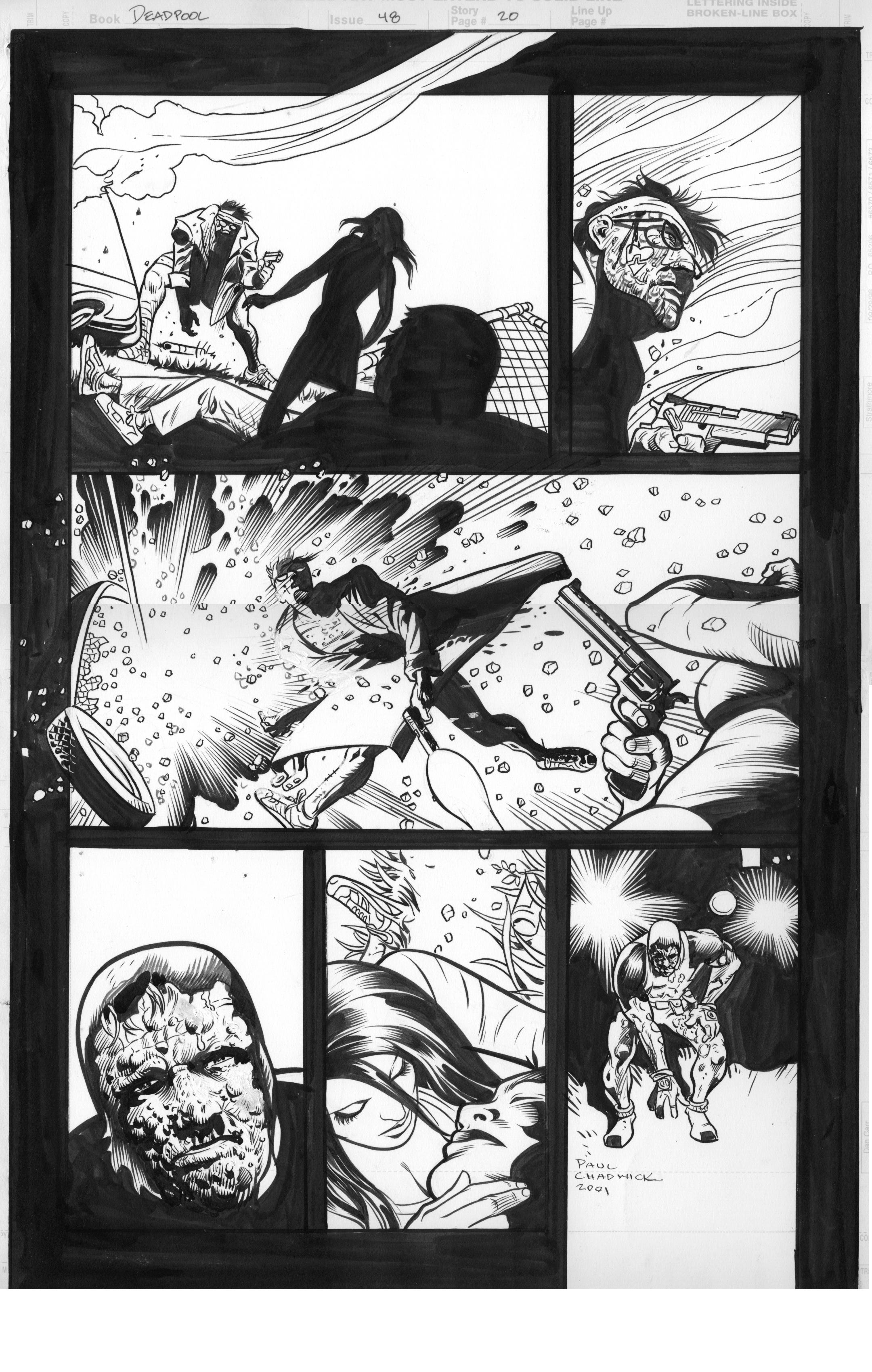
Other times I just draw the script I’m given. I didn’t understand Deadpool at all when I drew those issues. A horribly scarred (why is he cheerful and not wracked with PTSD?) mercenary (an amoral profession) who leaves a trail of dead bodies wherever he goes? Made no emotional sense to me.
I took me years to get it: Deadpool is a Bugs Bunny who kills people. Bad guys who deserve it. I was overthinking it.
BTP: Much of what we work on is a reflection and collection of our life experiences. What do you believe is core to the work you’ve done on your creator-owned CONCRETE series, and do you find it therapeutic on some level?
CHADWICK: Dan Clowes observed almost all comics are autobiographical, superheroes included. Most famously, Jerry Siegel’s father died of a heart attack a short while after the shop he manned was held up by a gunman. Superman surely was partly a way to heal the psychic wound of that injustice.
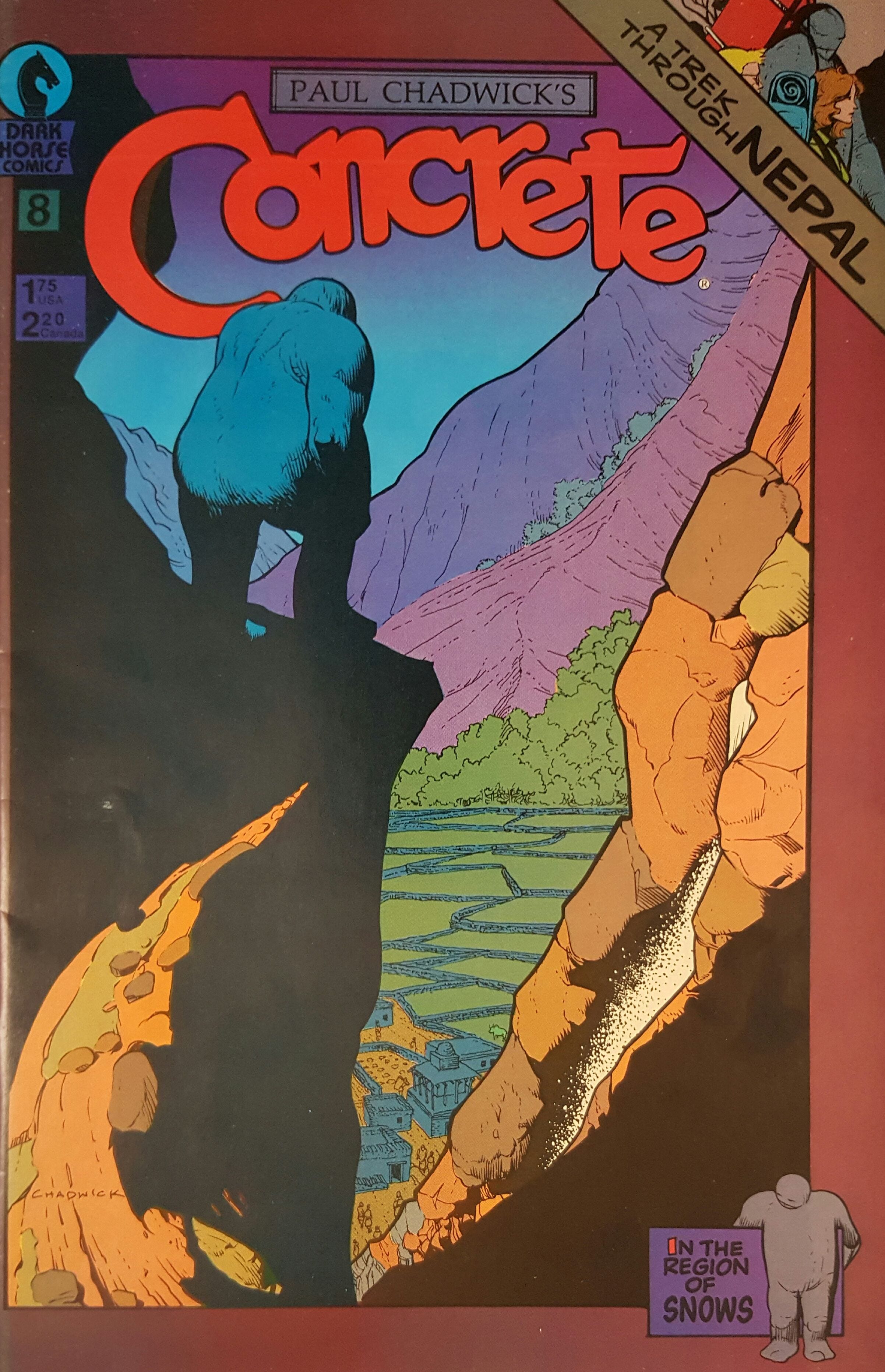
A lot of my life has made it into Concrete. Trekking the Annapurna Loop in Nepal. Working on the film After Midnight (and others) informed Fragile Creature. Think Like a Mountain was set here in Western Washington and I drew parts of it from life. Even Concrete’s origin drew on memories of a camping trip with friends in the Sierra Nevada mountains.
I don’t know if I’m working out a lot of personal issues with Concrete. It’s probably unconscious. But he’s wittier, braver, and more persistent than me. He never gives up. I guess it’s a conversation I’m having in my head (“Hey, Paul — here’s a way you could be better.”)
BTP: So, the stories around the fire we’re telling are us really saying the quiet parts out loud. Have you ever considered teaching writing or art? I remember you having been a mentor. Had you considered taking that further?
CHADWICK: I’ve mentored a few high school kids, some of whom have gone on to become accomplished in film and art and have become good friends. And I’ve substituted a couple of times. I have a friend who’s taught art here and at international schools, and it sounds beyond my capacities, frankly. All the certification, time documentation, and difficulties with over-pressured, under-motivated students sounds quite ghastly. Maybe I could swoop in for a multi-day workshop someday, but it’s not anything I’m pursuing.
BTP: You’ve spent a large part of your life in the Pacific Northwest with brief stints in California to attend the Art Center College of Design. What is it about this area that keeps you both grounded and inspired?
CHADWICK: I lived seven years in Los Angeles, first for school, then working at Disney for a year and different parts of the movie business thereafter. Then I moved to Connecticut to be close to New York, where I thought I’d pursue illustration once I got comics out of my system. But after seven years there I moved to the house my grandparents built in 1957 here on San Juan Island.
I had spent summers and some holidays here as a kid. It seemed like heaven. It’s a beautiful part of the world, and my grandfather Roy Halsey built a fine little compound: house, cottage, barn. He raised cattle briefly after a career in business, but not long. I realize now his heart was broken when his son died in a car wreck in 1960. I knew Roy as a taciturn, somewhat somber older man.
It’s been a safe, stimulating place to raise my son and we have many good memories here. Beach cookouts. Crazy dogs. Ferry trips. Orca pods. Northern Lights and meteor showers. Community plays. Small-town parades. The time the internet went out for a week and credit cards didn’t work. And the town has had several catastrophic fires in our thirty years here, which is kind of strange. My son’s a firefighter now.
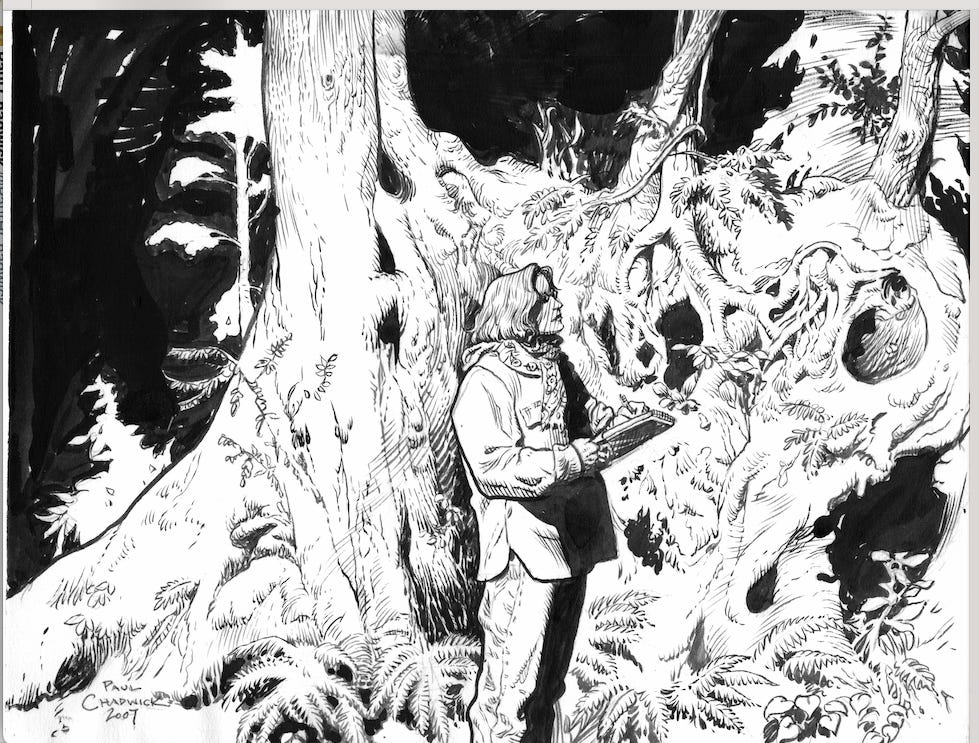
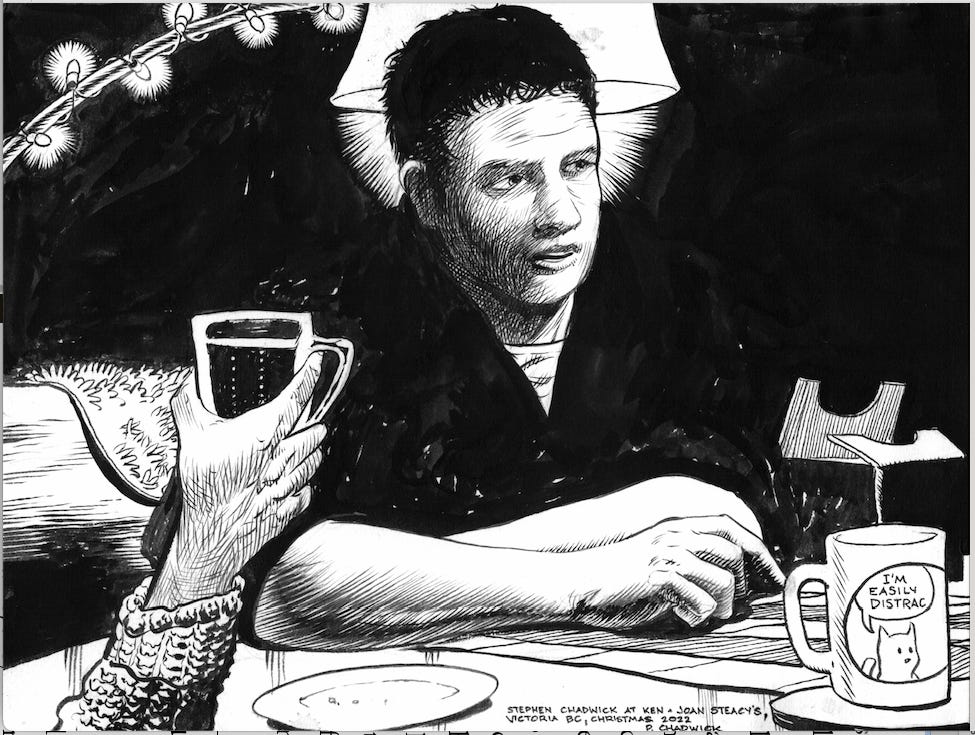
Inspired by Craig Thompson’s published sketchbook (Carnet de Voyage) of his European tour promoting his graphic novel Blankets, for the past decade I’ve been drawing local scenes. Then I ink them at home. Beaches, forests, our home and pond. It’s a big stack now. I exhibited them at the Community Theatre as part of a group show and sold a handful. Because they depict parts of my life (and often my family), I’m particularly fond of them among my work. I sometimes put Concrete in them, too.
BTP: I lived in Connecticut for seven months and that’s all I could take. The island sounds bucolic and a great source of stable-ish inspiration. I took a biking trip with my wife there. Just a lovely place. Those drawings sound amazing. Do you think you’d ever gather them up to publish them, like a Kickstarter? Have you ever considered creating a nice large, boxed edition of all the Concrete stories?
CHADWICK: Why didn’t you call me?! We have a guest cottage. Come visit, and bring work, or at least sketching gear. [SW: I might just take you up on that invite!]
What chafed about Connecticut? The winters? The ticks? [SW: Beautiful cookie-cutter living if you like colonial Americana. Some of the people were hands-down some of the shallowest I’d ever dealt with. They give LA a run for their money.] I have mostly good memories there, but we moved out west during a real estate crash and took a painful loss on our little house there. It was a nice place but on a country highway. Both our dog and our next-door neighbor’s dog were killed by cars. Poor Lucky died in my arms. Ana made it to the vet, but they couldn’t save her.
Yeah, I’d like to publish the personal drawings some time. It would be a vanity project, though, since interest in such a book would be pretty niche. As for Concrete, Dark Horse is planning on issuing collections around the time Stars Over Sand and Stone Cold Truth come out. It will be nice to see them in a large format again.
BTP: When you were working on films like STRANGE BREW, PEE WEE’S BIG ADVENTURE and THE BIG EASY, as an illustrator and storyboard artist, were you actively trying to get work in comics in between gigs? How much earlier did you start submitting work to publishers before your first gig on Dazzler in 1985?
CHADWICK: It’s not a terribly coherent timeline. Yes, I mixed film and comics work in the beginning. My first comics gig actually came from a classmate at Art center, Bill Dinardo. There is an order of Norbertine monks in Southern California, and they wanted a comic about Saint Norbert’s life to inspire boys to join the order. Bill knew one of them, who wrote the rather wordy script. Bill’s style is gently cartoony — think Rick Geary, though more serious. He wanted me to pencil more realistic figures and backgrounds and such, which he then inked and watercolored. Our styles meshed pretty well.
Eventually I decided to leave movie work and get a comics career going. In fact, originally I turned down The Big Easy. Elizabeth, whom I’d married a handful of months earlier, brought me back to sanity. A paid trip to New Orleans! I called back and we had a wonderful second honeymoon, and one of my best movie work experiences.
Actor Ned Beatty brought his family to the production office and asked for them to see the storyboards. Unfortunately, the sequence that was out had his character dead in a fishing net! The production coordinator said, “Daddy’s sleeping in that one.” Quick thinking.
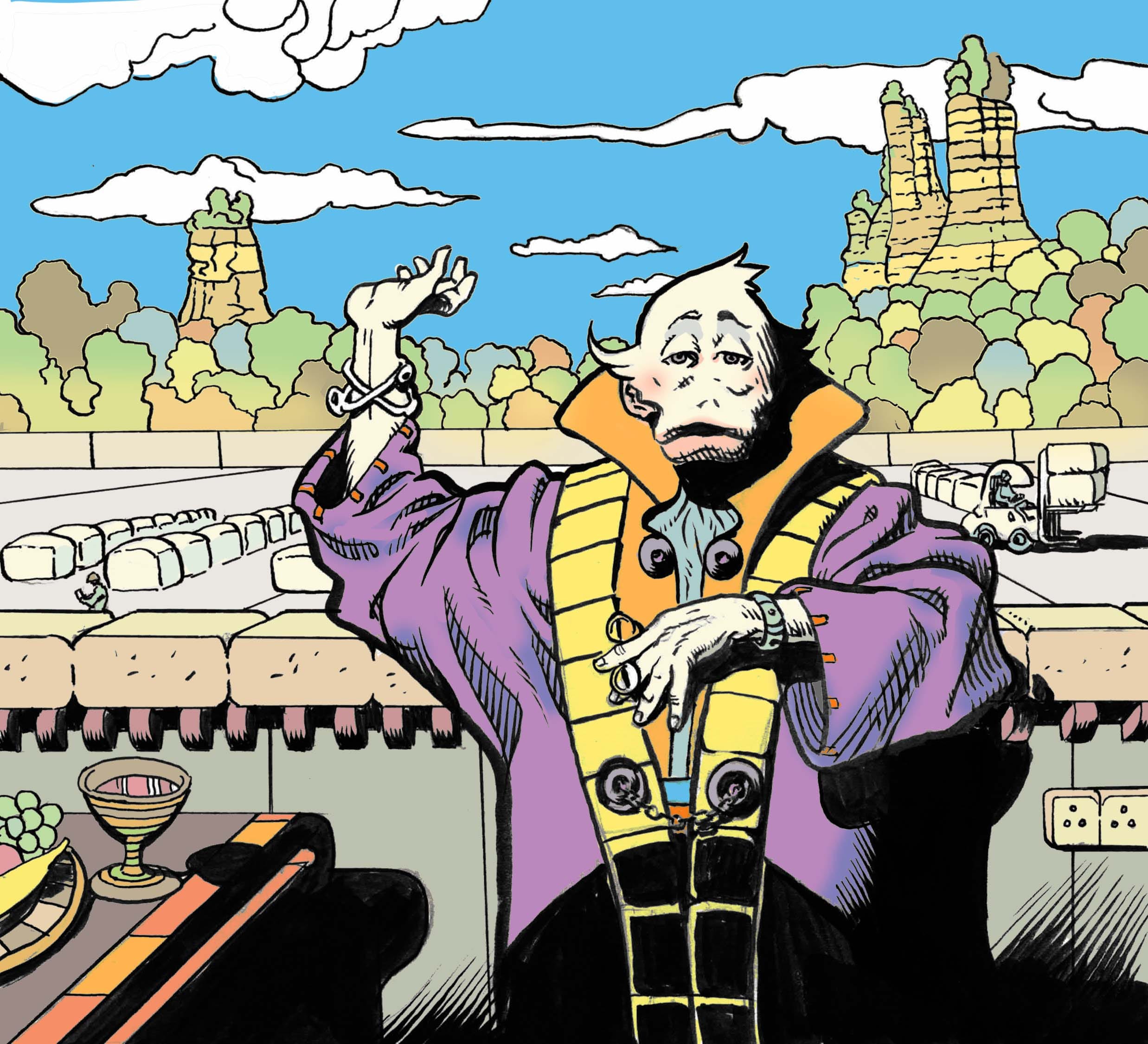
My second comics job was Salimba for Pacific Comics. From the sacred to the silly. Salimba was a black jungle queen character whose antagonists were out of DC weird comics of the 60s. Worm boys. A three-headed were-hyena woman. Handsome pirates who turn out to be dead.
It was madly written by Steve Perry, who a couple decades later met a terrible end. He got cancer, pleaded for help from comics friends, then was murdered by his druggie roommate for the money he’d received. His parts were deposited in a series of dumpsters along a Florida highway.
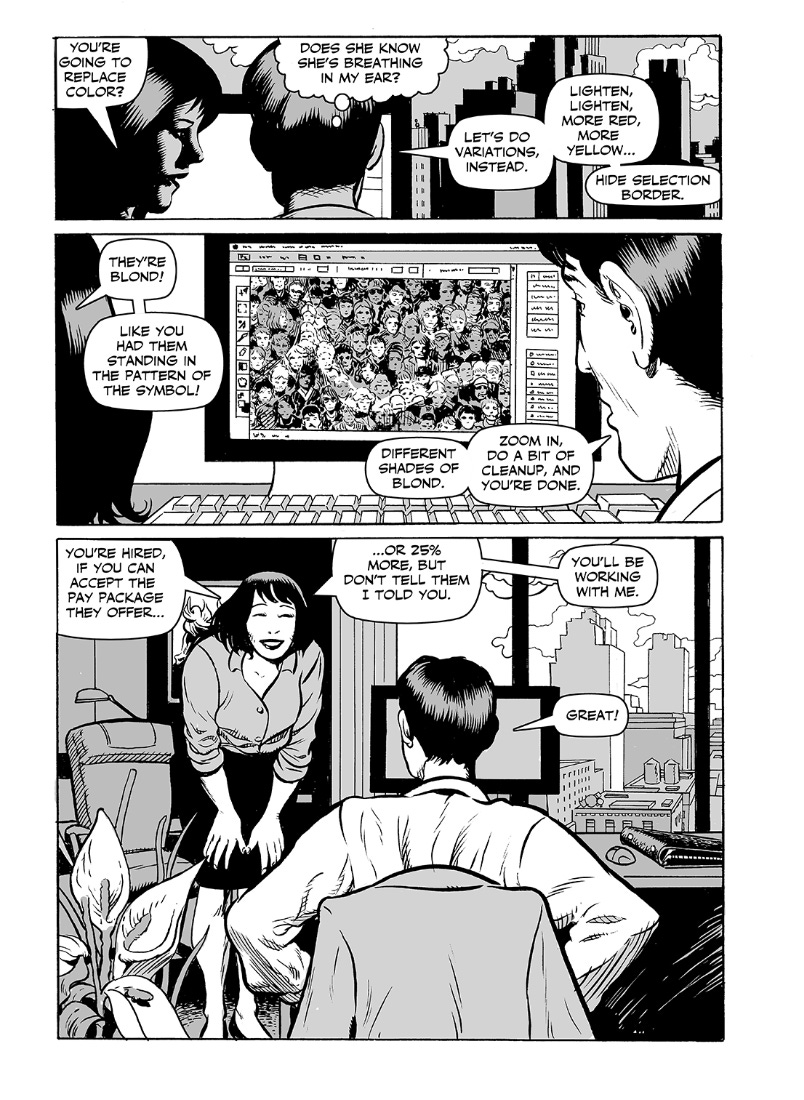
After that I did Dazzler for Marvel. So great to have crossed paths with writer Archie Goodwin, a loved and respected figure in comics. Archie was the one who designed her new costume, less disco and more aerobics instructor.
BTP: Yikes, that’s brutal about Steve. I remember Salimba. Pacific Comics was putting out a bunch of beautiful work back in the day, notably Dave Stevens’ The Rocketeer. Archie Goodwin was legend too. I’ve heard nothing but good stories about him. Once you “broke in” was comics everything you’d hoped for in making a living? Was there a book that you would have wanted to really make your mark on?
CHADWICK: Well, my mission was to do Concrete from the beginning. In its heyday, and with the screenwriting fees that materialized, I was pretty happy. No change in page rates for 20 years here has made comics less viable these days, but I inherited some from my father, and that’s kept us solvent.
Never had a childhood favorite character I desperately wanted to do. I would’ve tried! There’s a heroic fantasy series set in an Arcadian past that I shopped around, as off-genre as Concrete is to superheroes. That sprang from the way I felt looking at somber Symbolist paintings; as lyrical and moody as Concrete is semi-comical. Never sold it. I’ve finished an issue, but who knows if it’ll ever see print.
BTP: As creatives we can get a little inside our heads. How have you been able to keep a healthy perspective on your own endeavors and keep your audience for as long as you have?
CHADWICK: That question is maybe too generous. In fact, I am a slow artist, and not very diligent, and have disappeared for years at a time. The momentum of my career has suffered for that. Readers move on. But I occasionally get emails from people expressing real gratitude and appreciation, some of them quite accomplished themselves, and it always makes my day. So I’ve hit some people at the right time in their lives, and left an impression.
I do spend too much time in my own head. The only antidote is camaraderie, and once a week I host a lunch for a small group of writer-artists, where we share what we’re working on, make suggestions, and cheer each other up as we face the void.
BTP: As I’ve grown older, I realize how much harder it is to maintain a sense of community. If you don’t put in the work, you end up empty handed. I’ve heard you say a few times that you were a slow artist. I also believe that everyone has a pace in which uncompromisingly or not is the frequency they can create work they’re comfortable with. How long does an issue of CONCRETE take you from writing to lettered pages? I think a reality check like that might help people understand that quality takes time and diligence.
CHADWICK: I once spoke at a prep school in Connecticut alongside an accountant. A career day kind of thing. We were asked about our typical day, and he gave a precise picture of how he allotted his time. I had no clue. Working at home, it all bleeds into everything else. How long things take is quite mysterious.
Recently Ken Steacy brought me in on a job illustrating Biblical parables for a YouTube channel. It was the first work on deadline that I’d had in years. In a way I liked the focus it gave me, but it was exhausting! Still, it was nice to put in a few weeks work and get a check back immediately. Not my usual way of working.
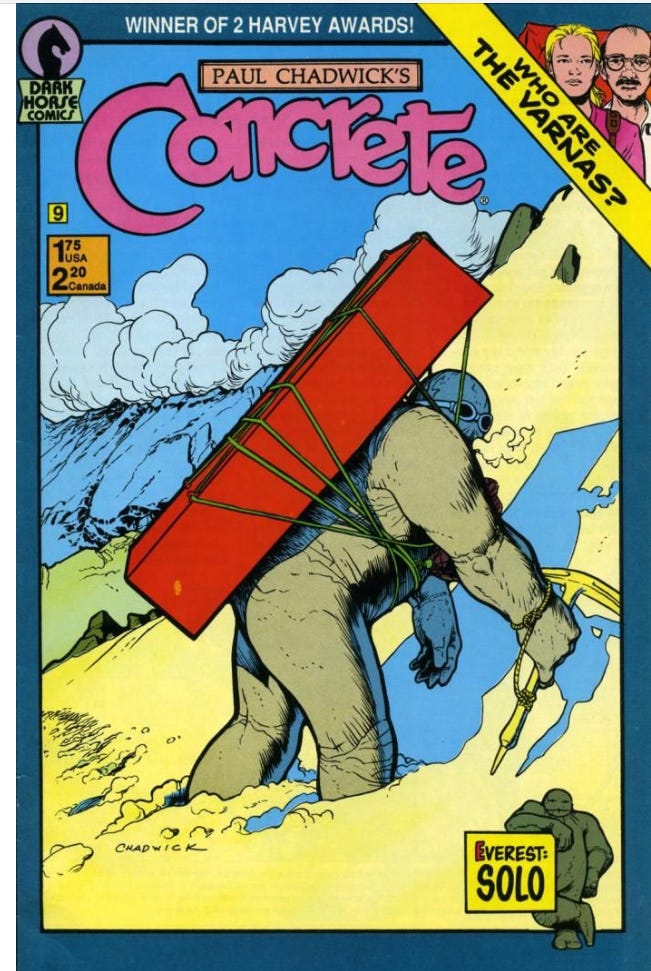
I would guess in recent years I’ve produced a 25-page issue of Concrete at the rate of…one a year, maybe. Including color and lettering. I do other things, of course; I’ve probably made more managing our vacation rental than doing comic art in the last twenty years. But you don’t call me if you need a speed demon.
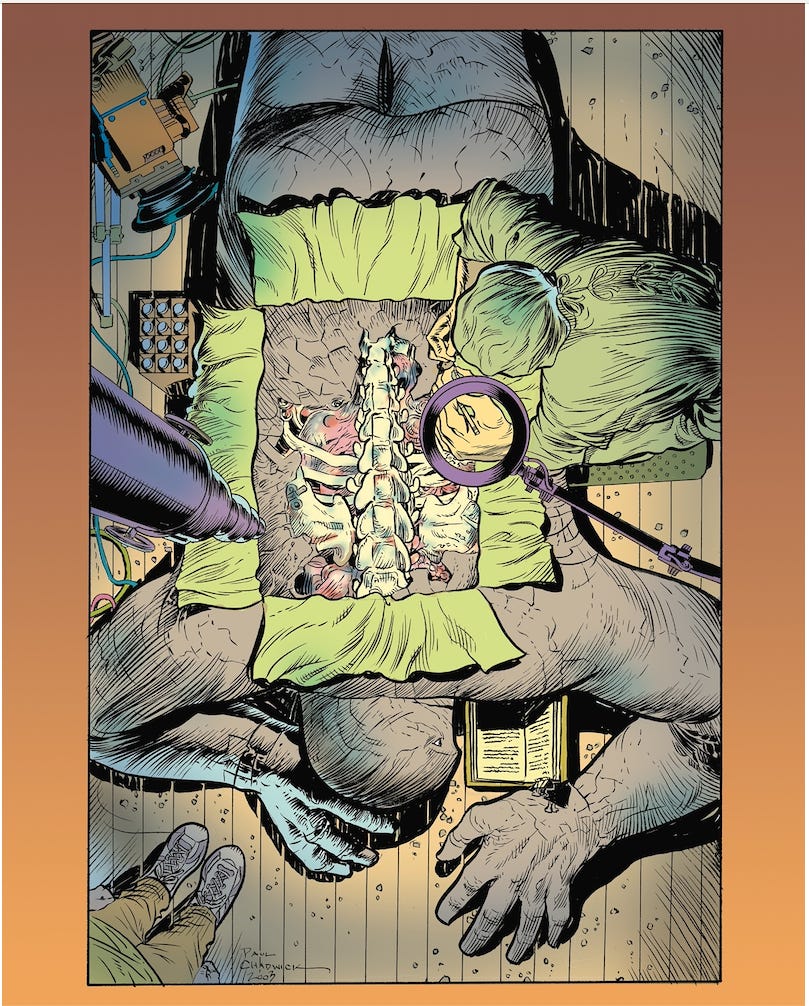
BTP: I’ve always liked your linework, especially on CONCRETE. There’s a subtle and sensitive nature that, at least to me, seems to be a direct reflection of you as a person. Seriously you’re one of the nicest people I’ve met in comics. Very generous with your criticism and time but you don’t suffer fools either. You’re like a quiet force of nature. If you were to think of your legacy, do you feel like the entirety of your work on CONCRETE would fairly summarize it or is there something else?
CHADWICK: There are a few questions here. I do have a fine line, though it can work against me. My drawing gets soft sometimes, and precise linework amplifies mistakes.
There are times when I wish I’d weighted things toward a bolder, more animated style, which allows distortion without looking wrong. Think Paul Pope, Tom Fowler, Daniel Warren Johnson. I love their work. But my lines just don’t go that way; it’s not something you can will into existence.
I’m not kidding about my soft drawing. In Best Wishes, the graphic novel I did from Mike Richardson’s story treatment, I found when making corrections on the scans I would adjust eye lines and mouth-to-nose distances on almost half the pages. Important to get a pretty character’s face right, and boy that gets away from me.
I suppose I am a nice guy, though I’m no Scott McCloud! I do in fact suffer fools; patience is a virtue, but I can be a bit tardy ending ridiculous conversation. Conventions exhaust me.
You’re probably right that Concrete’s my best shot at being remembered. None of my other comics work made waves. I’ve painted a few SF book and magazine covers, and might’ve gotten somewhere if I’d stuck with it, but I cast my lot in comics. Storyboarding and production illustration are just tools to make a movie, lucky to achieve a modest afterlife in special-interest books. I’ve finished a (Concrete) novel and am at work at another, but I’m not blazing with the creative fire of a younger man. Still, you can make a hill if you keep piling up pebbles.
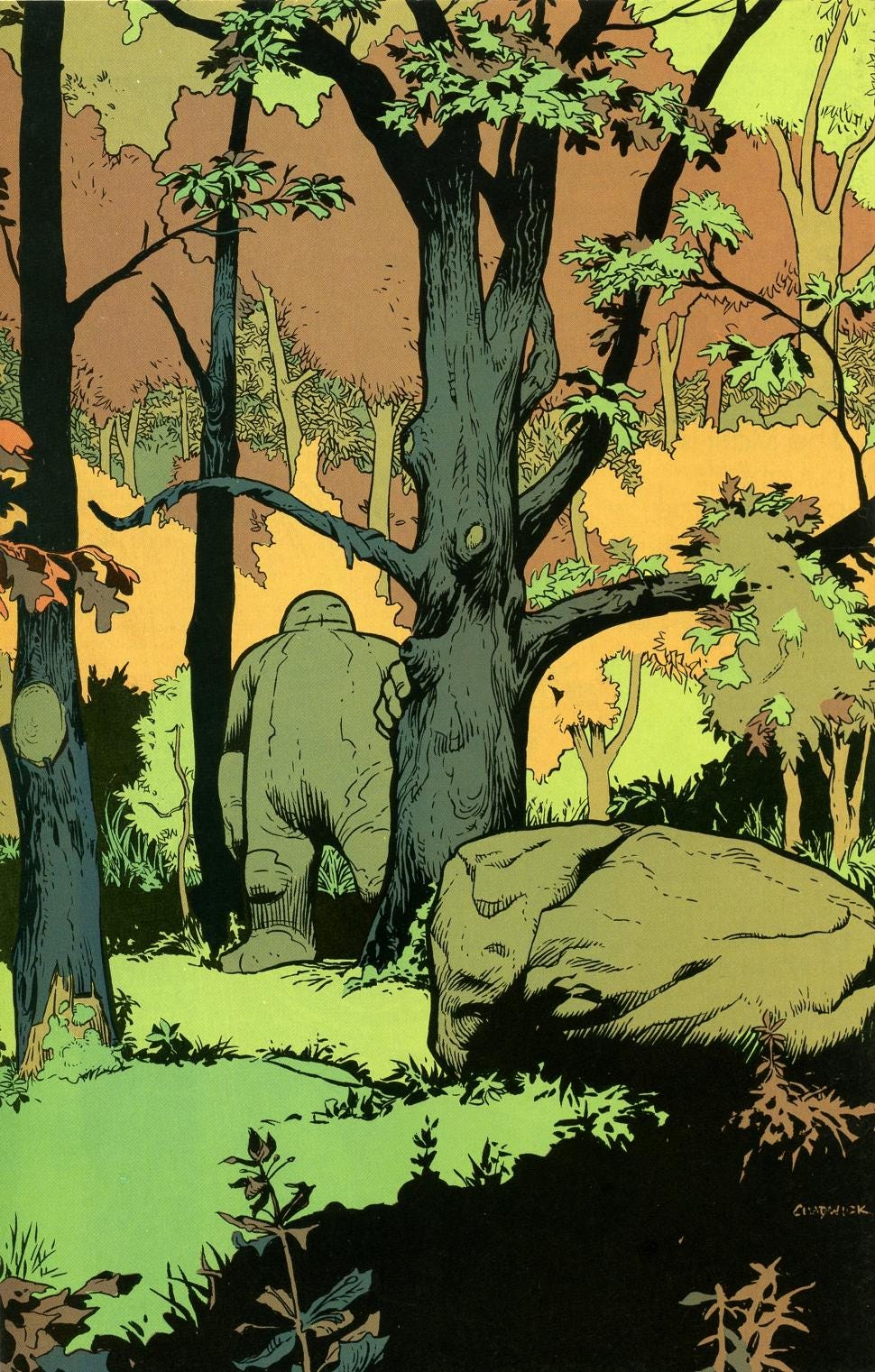
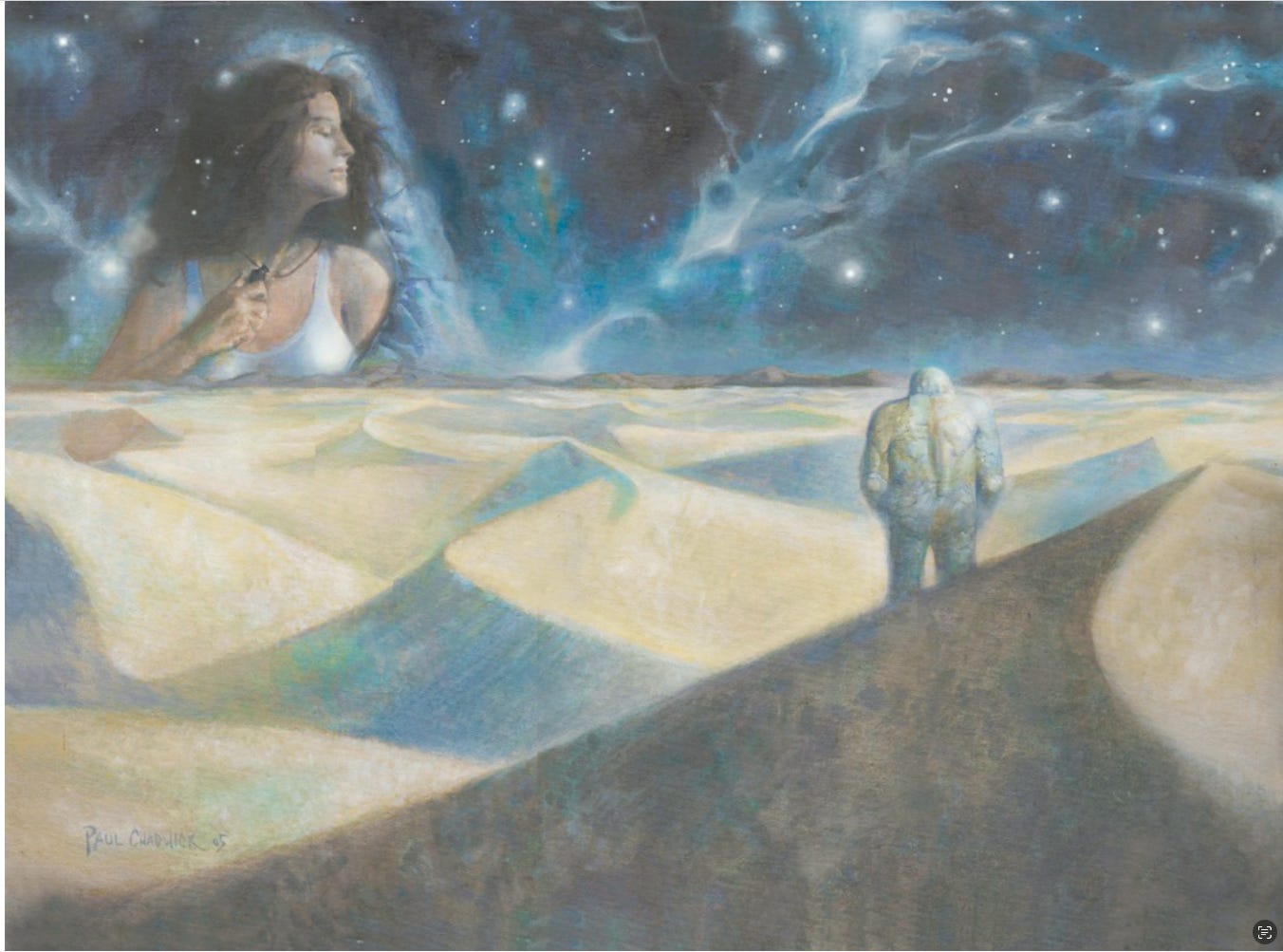
BTP: I guess that’s the thing about CONCRETE, as a character he’s a strong presence, a foundation to build on. Your persistence are the gears that keep on turning. I’d also add your paintings and your color theory are something I wish more people could see. Would coloring CONCRETE in watercolor with the lighter linework I’ve seen you use ever be an option for you?
CHADWICK: Appreciate you not calling attention to the puns you’re making. Puns should never be accompanied by a wink. They should just be spewed, the way comedian Dennis Miller did before his political phase.
Maybe I should try a watercolor story. I certainly don’t digitally color any faster. I can barely color a page a day in Photoshop. I don’t understand how people make a living at it. And the linear restraint needed for watercolored art might even save some time in the inking.
I have strong opinions about color in painting. I favor analogous color, with, say, a coolish or greenish or orangeish atmosphere throughout; if complimentary colors are present in the same image, they are best isolated with areas of neutral grays or browns preventing them from abutting each other. And generally the feeling of colored light in a scene is best achieved if the lightest color is the most intense. That can be tricky when your intense accent is red, a dark color itself. Best to have very dark purples, browns or blacks around it if it’s your highlight. Mignola’s colorist Dave Stewart often hews to this principle when coloring Hellboy with his red skin. Mike’s generous use of black areas helps too.
I do have an unfortunate color habit: I reach for ultramarine blue far too often. When the FPG fantasy art trading card set was printed, there was blue painting after blue painting. I wish somebody should slap my hand while I’m painting occasionally.
BTP: From what I’ve read, there have been a few screenplays written for a CONCRETE film over the years. If you were to have your druthers, would you prefer it as a standalone movie, a series and would it be live-action, 2D animated or 3D animated?
CHADWICK: Came pretty close at Disney in the early aughts! Script by Peter Jackson and Fran Walsh, who did the Tolkien films. But there are a million ways for a movie (or TV project) to die, and Concrete’s explored a few.
I co-wrote a script with Larry (Beetlejuice) Wilson, but it too went unfilmed.
Zak (Ready Player One, The Avengers, Free Guy) Penn wrote a TV pilot with Ira (ST:TNG, Outlander) Steven Behr most recently. Briefly greenlit at UPN, until parent company Sinclair decided to get out of scripted TV.
Over the years Bill Murray, Andy Serkis and Peter Dinklage have expressed interest in playing Concrete. If only!
Chris Columbus and Joe Johnston both passed on it when offered. My dream director would be Brad Bird.
And yes, I’d most like to see a live-action film or TV series, but animation would be fine, too. I just saw Flow, a gorgeous and emotional film done entirely on a single desktop computer (if I got that right). Maybe a low-budget Concrete would make the most sense. It’s not going to please anybody expecting a Marvel extravaganza.
I suspect Concrete has missed the comics/superhero window. But who knows.
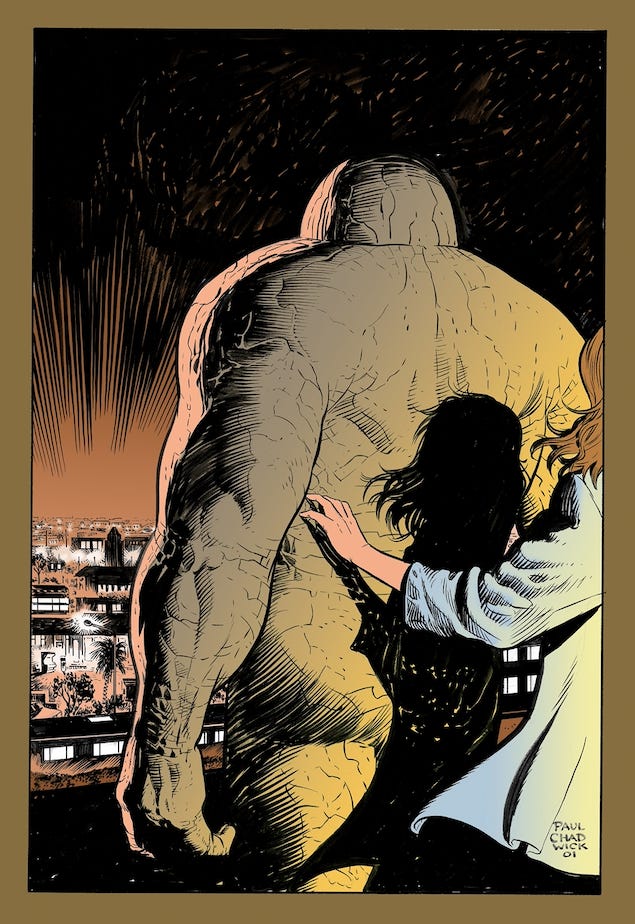
BTP: It seems to me that CONCRETE would actually transcend that “genre” of movie. I mean, there’s something of the Golem mythos at work here, and yet he’s so very specific and terribly interesting. The psychology of having one’s brain transplanted into a form that could live indefinitely is both universally appealing and terrifying. In your world, what appeals to you these days, what brings you great joy? What do you believe is the antidote to the fear that we face with every news cycle?
CHADWICK: No question, we’re not built to be this plugged in to the strife of the whole culture and the whole world all day. I’ve tried news fasts, and I frequently use the social media blocker for Macintosh, “Self Control” (it’s a free download). But two and a half decades of news-junkie habits linger in me, I admit.
I do still love comic art. I buy very little — I need more paper in this place like I need another inch on my waistline — but the great comic artists on X and Bluesky and Instagram delight me every day. Beyond those I’ve mentioned, let me recommend following Dan Panosian, Bilquis Evely, LIam Sharp, Valeria Burzo,Patch Zircher, Gabriel Rodriguez, Simon Roy, Jen Bartel, Shawn McManus, Colleen Doran, Aaron Lopresti. You too, Shane! Comics has more great artists than ever.
I’m delighted to have lived so long as to see the astronomical wonders current technology has captured. The Cassini photos of Jupiter, the New Horizons mapping of Pluto — just incredible. The Hubble and Webb views of the many, many galaxies we could only speculate existed forty years ago, now recorded in tremendous detail. It doesn’t affect our lives like a drink of water or paying a power bill, but it adds a richness.
Like many comics people I’m not a natural athlete, but I have taken particular interest in cultivating range of motion in my body at this age. I attend a stretch class for older men, follow Kelly Starrett and the MovNat (“Natural Movement”) people on YouTube, and try their exercises at the gym most days (I also lift). My squatting has improved measurably in the past year. It makes me wish I’d drawn my pages cross-legged on the floor, as Alfredo Alcala did. I bet he stayed limber and strong. Every hour in a chair is an hour you’re losing capacity. I try to do what work I can at a stand-up counter now, too. You know Philip Roth wrote all his novels standing up? It can be done.
Can’t say I’ve figured out how to live the good life, but these things help me cope.
BTP: I want to thank you for joining us today, Paul. We really do appreciate it. Where can people find out more about you and your work?
CHADWICK: I’m on Instagram, but I seldom log on; I find it a little overwhelming, all that video. I have a threads account too, but almost never post. You can find me here:
Website: paulchadwick.net
Bluesky: @paulchadwick.bsky.social
X: @PaulHChadwick
Amazing interview of an incredible artist! So cool.
Oops! Wikipedia tells me Burn Hogarth's farewell tribute was at the French comics festival at Angouleme, not Lucca, which is in Italy. Très bon!